

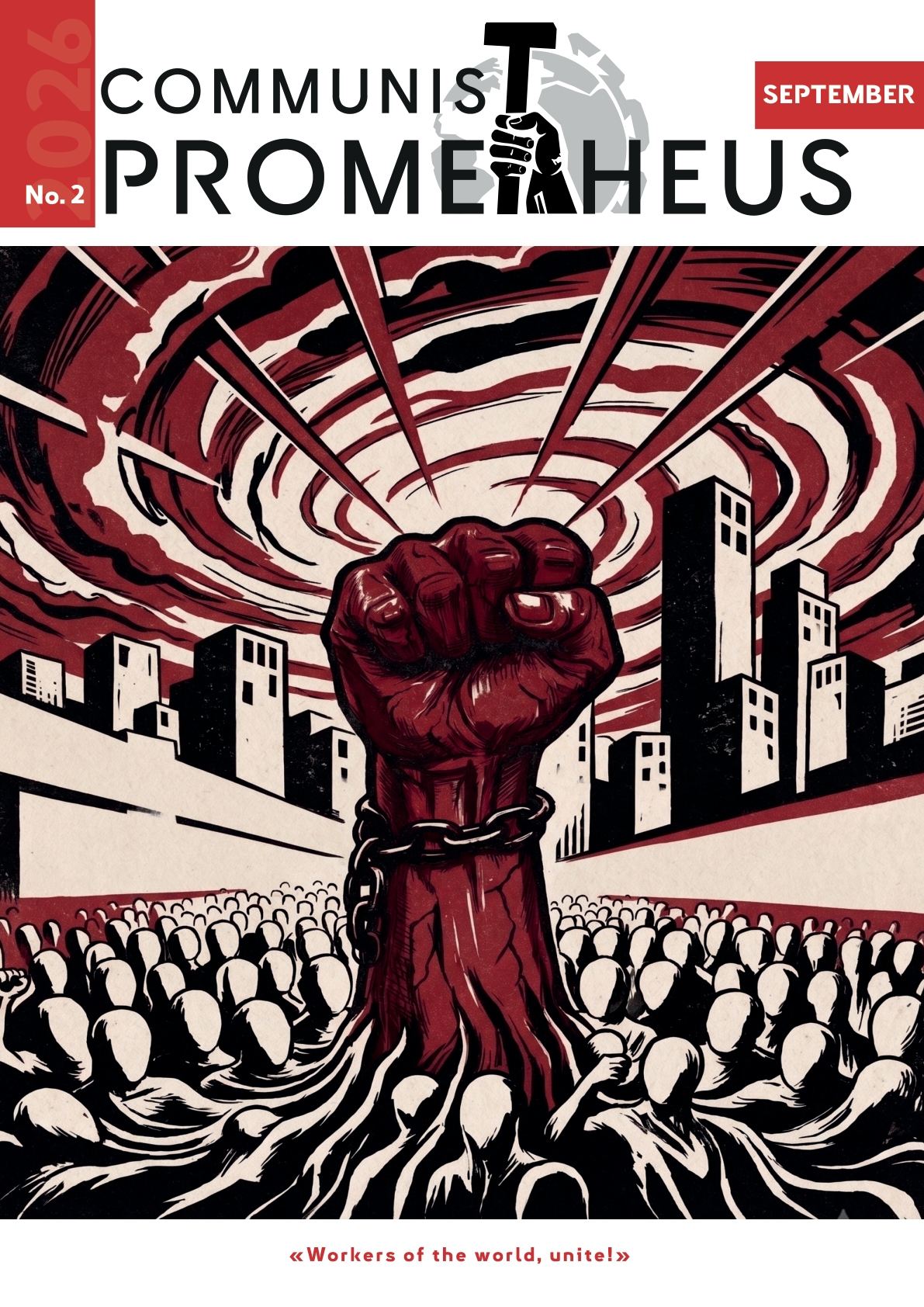
There is no revolutionary party of the proletariat in Russia. The working class stubbornly refuses to recognise its historical task. Meanwhile, the damned Zionists, Trotskyists, and Stalinists (take your pick) with their vile provocations prevent Marxists from uniting and organising the proletarians to “overcome alienation”. It’s enough to drive one to hang themselves. And that is precisely what the bourgeoisie wants, is it not? Perhaps the problems are not as insurmountable as they are painted? Is it not time for communists to believe in their own strength and set to work in earnest?
It’s a truism that «the ideas of the ruling class are in every epoch the ruling ideas»1 (Marx and Engels, The German Ideology). Furthermore: «the working class… educated, traditional, and accustomed to the conditions of that mode of production, looks upon those conditions as self-evident natural laws»2 (Capital). It follows from this that one should not wait for a “windfall” – for the proletariat to “mature” and “give birth” to its vanguard, the communist party. In reality, the category of economic class – as a large group of people occupying a definite place in the process of social production – and class as a subject of political struggle do not coincide perfectly, but with a certain “displacement”. The more the contradictions of society intensify, the more representatives of the “middle” and even “higher” classes come to recognise the necessity of revolutionary transformations. The process develops in parallel: on the one hand, the spontaneous workers’ movement for better conditions of labour and life takes on definite forms (trade unions, councils); on the other, within the ranks of the intelligentsia (which, by virtue of the existing social division of labour, holds a monopoly on the development of thought), the theory of socialist revolution and the methods for its achievement mature. Only when these two currents merge is a revolutionary party of the proletariat – the communist party – born.
This process has been outlined in principle. But has it become outdated?
As far as theory is concerned, modern Marxists find themselves in a position both easier and more difficult than their predecessors at the beginning of the twentieth century. Easier because, over the past hundred years, capitalism has expanded exclusively in breadth; it is no longer capable of any qualitative leaps. More difficult because there exists a vast negative experience of the “construction of socialism”, which is fully exploited by bourgeois counter-propaganda. Therefore, explaining the history of the twentieth century, and doing so from the standpoint of dialectical materialism, is one of the most important tasks for theoreticians at the turn of the millennium. Yet this is still history, and it should not serve as a stumbling block for contemporary communists – we are confronted with the necessity of a new revolution, and therefore the paramount task now must be an understanding of the need for joint action, despite theoretical disagreements. Unity is impossible with opportunists, with those who place the tasks of political self-preservation above the interests of the common struggle. Unity is impossible with those who advocate a bloc with the “national” bourgeoisie against the “comprador” bourgeoisie in the interests of Russia’s supposed national liberation movement. Anti-Semitic rhetoric cannot be justified by any, even the noblest, intentions.
Nor is unity desirable with those who glorify “humanism” and “democracy” in abstraction from their class content, which in practice amounts to primitive anarchism and binds the working class hand and foot. Those who see the sole problem as the absence of a proletarian vanguard must unite, for such people need only take one step – to look in the mirror!
If we have recognised the necessity of socialist revolution, if we see that the only force capable of accomplishing it is an organised and active working class, if we are already engaged in the work of enlightening and organising the exploited masses – then we are precisely that vanguard of the proletariat. Yet we act in a fragmented, amateurish manner, whereas we are compelled to act on a mass scale, professionally, and in a centralised manner.
Only then will the workers “notice” us. After all, class consciousness arises not so much by virtue of “economic origin” as in the course of class struggle, and that is precisely what we are waging. The working class can give rise to labourists, nationalists, and apathetic elements – there is nothing surprising in this. It is naive to regard every workers’ protest as the beginning of a revolution. On the contrary, we must not yield to spontaneity; it is necessary to intensify propaganda and our own organisational presence within the workplaces, up to and including the creation of party cells (even if underground). However, serious work in this direction is impossible without coordinating efforts with Marxists across the world, beginning with those who are easiest and quickest to reach.
The task of enlightening the working class is greatly facilitated by the availability of legal Marxist literature, but is complicated by its excessive breadth. Communists must therefore go beyond the false dilemma of “Stalin versus Trotsky” and deepen their study of the classics. Only a theoretician whose theses have been confirmed by practice can be recognised as an authority. After Lenin, it is difficult to name any such figures, with the exception of certain insights from individual comrades. It is therefore necessary to stand firmly on the principled slogans of Marxism, without referencing specific names too often. The classics bequeathed to us the task of developing theory, not of pounding water in a mortar, as has been done for the last seventy years or so.
Of course, one could wait a little longer until all workers have independently studied (if they so wish) Capital and the Manifesto of the Communist Party, but would we not thereby be rendering a service to our class enemies – the capitalists? It is very easy to justify one’s own impotence by the “unpreparedness” of the proletariat, but where is this preparedness supposed to come from?
There is a manifest growth in workers’ interest in our propaganda, so is it not time to come to our senses? Surely, someone has to do it?!
To delay any further is a crime against the working class of Russia and the entire world.
The proletariat can never become a “class for itself” if we – its vanguard – are unable to recognise our own inner unity.
March 1999