

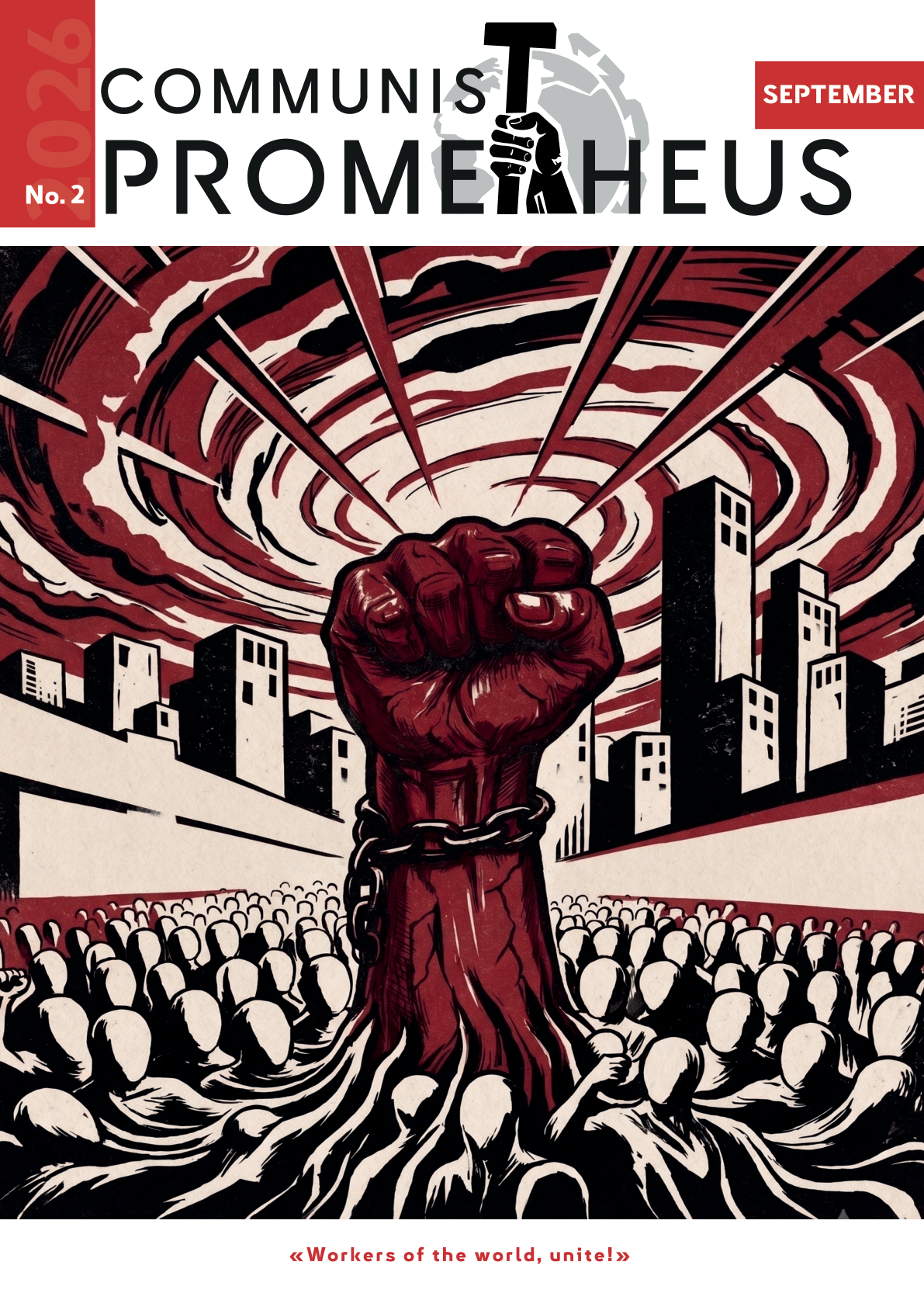
Communist Prometheus

“Communist Prometheus” is a group of revolutionary Marxists who view their activity as part of the worldwide movement of the working class for the overcoming of capitalism. We are grounded in the programmatic core of the “Manifesto of the Communist Party” and proceed from the position that communism is neither a utopia nor an abstract ideal, but a historical necessity arising from the very development of modern society.

Read more →

Latest materials

History

Analysis of the Development of Capitalism and Revolutionary Strategy

The article presented here was originally conceived as a conceptual preface to a book, still unpublished, on the history of the spread of Marxism in Russia and the formation of the first proletarian organisations, which we were preparing for the centenary of the October Revolution. The true history of the workers’ movement is inconceivable without a rigorous analysis of its material basis. For this very reason, the central task of the research was to examine the objective socio-economic conditions of the Russian Empire at the turn of the twentieth century – the actual historical foundation from which the Bolshevik Party organically emerged and on which it rested. Without a clear understanding of the specific character of Russian capitalism, closely interwoven with the remnants of serfdom, it is impossible to understand why Lenin’s revolutionary strategy proved to be the only correct one, while its political opponents inevitably lapsed into opportunism. Today, when mountains of ideological rubbish have accumulated around the history of the revolutionary movement, it is particularly important to dissect the persistent myths that distort the actual class alignment of forces on the eve of 1917. This work exposes the striking class affinity between the positions of the social-chauvinist Plekhanov and the social-imperialist Stalin – the future embodiment of the counter-revolution – in their denial of the independently imperialist character of Russian capitalism. By examining the anatomy of Russian military-feudal imperialism, the article demonstrates that Lenin’s uncompromising line of advocating the defeat of his own government in the world slaughter and the transformation of the bourgeois revolution into a socialist revolution was not a voluntarist leap, but a rigorous scientific conclusion arising from Russia’s objective position within the world capitalist system.

Class struggle worldwide

Ebb Tide After the High Tide: The Labour Movement Between the Two World WarsPart I

The text presented here continues the series that began in the previous issue of our journal with an article on the class struggle around the world. This piece, published in two parts, examines the period between the waning of the postwar revolutionary wave of 1917–1921 and the outbreak of World War II. In the first part, we will examine how the world proletariat suffered a series of devastating defeats in the 1920s and early 1930s—from the degeneration of the dictatorship of the proletariat in the USSR and the defeat in Italy to the failure of the general strike in Great Britain, the tragedy in China, and, finally, the triumph of Nazism in Germany. The purpose of this text is not to chronicle individual strikes, but to reconstruct the process of the working class’s retreat, deprived as it was of a unified revolutionary leadership.

Technology

Sandcastles of Fictitious Capital: AI Infrastructure and the Material Contradictions of Capitalist Accumulation

The November slump in the technology market, which wiped billions off the capitalisation of the sector’s giants and was accompanied by the sale of bank loans for data centre construction, exposed the vulnerability of the global artificial intelligence boom. The bourgeois press reduces these events to political conjuncture or a temporary market cooling. Behind the stock-market bulletins, however, lies a fundamental question of political economy: is the AI industry capable of securing – whether through production or appropriation – a mass of surplus value sufficient to pay back its infrastructural investments, or are we witnessing the inflation of a bubble of fictitious capital? At the centre of our inquiry is the structural gap between the multi-year cycle of building gigawatt-scale facilities and the rapid moral depreciation of the technological core, which demands payback within three to five years. Through the categories of the organic composition of capital and monopoly rent, this text analyses the nature of contemporary overaccumulation. We examine how the expectation of sustained demand is propped up by mutual commitments within a narrow circle of technology corporations, the extraction of rent, and the exploitation of a globally distributed proletariat across the imperialist supply chain.

Manifesto of the Group “Communist Prometheus”

Our mission, core principles, and commitment to democratizing knowledge and open-source collaboration.