

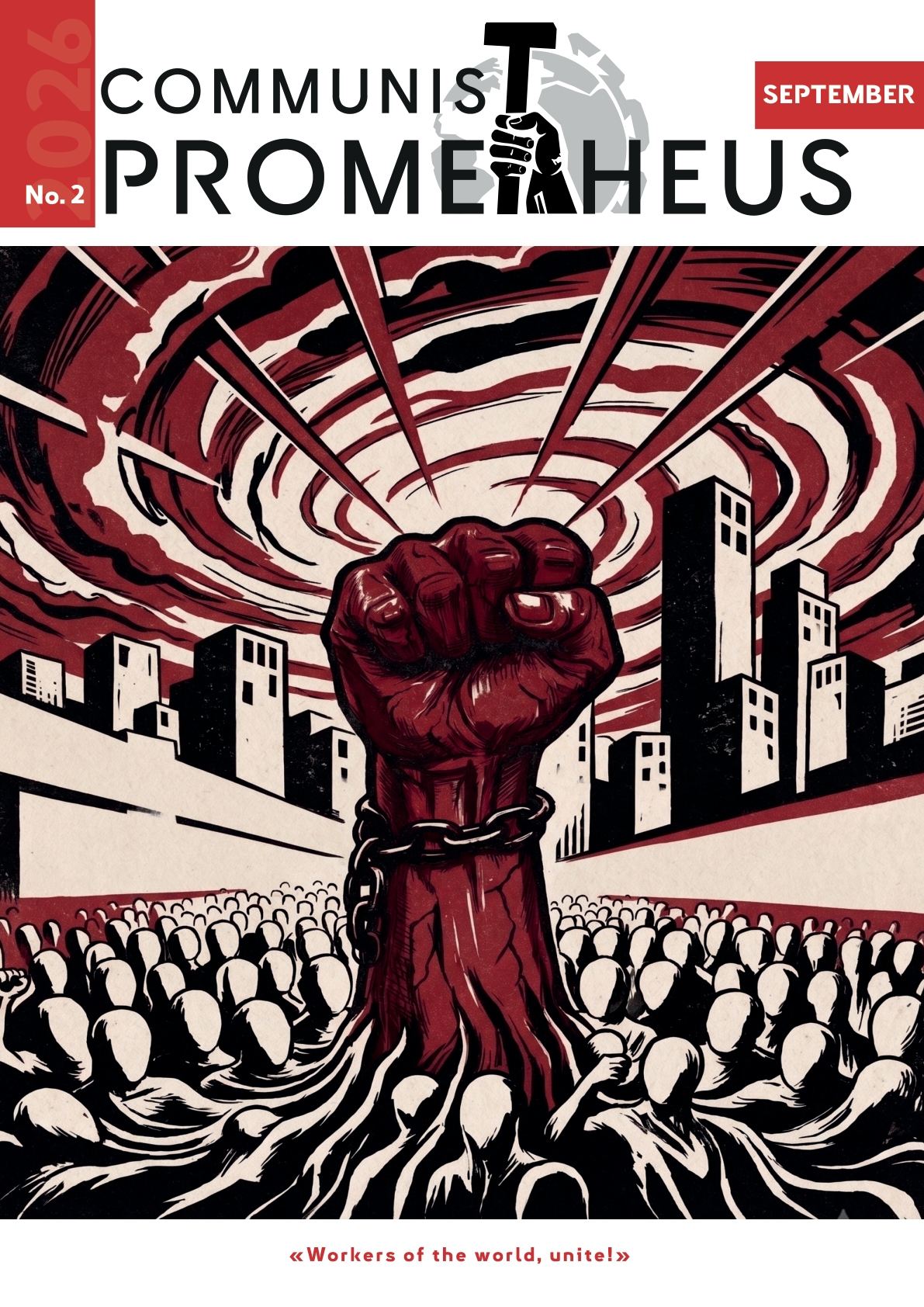
Contents
- THE TENDENCY OF THE RATE OF PROFIT TO FALL AS THE FUNDAMENTAL CONTRADICTION
- THE TURNOVER OF CAPITAL, THE “ANNIHILATION OF SPACE BY TIME”, AND TRADE WARS
- CREDIT, FICTITIOUS CAPITAL, AND THE DEBT NOOSE
- THE CENTRALISATION OF CAPITAL AND STATE-MONOPOLY DIRIGISME
- THE REAL SUBSUMPTION OF LABOUR: FROM THE FACTORY TO THE GLOBAL CHAIN
- OVERACCUMULATION AND THE PHYSICAL RESOLUTION OF THE CRISIS
- THE METABOLIC RIFT: THE EXHAUSTION OF NATURE AND THE WORKER
- THE RESERVE ARMY OF LABOUR
- ON THE EVE OF WORLD WARS: THREE EPOCHS OF A SINGLE CONTRADICTION
- CONCLUSION: THE REALM OF NECESSITY AND THE TASKS OF THE REVOLUTIONARY VANGUARD
INTERNATIONAL REVIEW: JULY 2026
Davos, January 2026. In a hall overlooking the snow-capped Alps, amid the applause of those assembled, a “Council of Peace” is established – a closed club of investors whose entrance fee, rumour has it, amounts to one billion dollars. At one table sit representatives of Israeli capital and the monarchies of the Persian Gulf, who only yesterday were in a state of war or on its very brink, yet today lean unanimously over a map of Middle Eastern ruins with one single concern: who will receive the contract for their reconstruction. In the adjacent window, a stock-market ticker displays the capitalisation of Nvidia, which has just surpassed five trillion dollars, while one line below, the quotation for oil creeps silently, still unsettled following the missile strikes on the oil-and-gas infrastructure in the region of the Strait of Hormuz. No one in the hall finds anything unnatural in this juxtaposition. Not a single irregularity of pulse, not a shadow of embarrassment – the appraisers of ruins work with the same businesslike methodicality with which, only yesterday, they calculated the logistics of the strikes themselves. Julio Jurenito1, that great teacher and provocateur, would undoubtedly have appreciated this “Council of Peace” for what it is worth: here we have not mere cynicism, but the metaphysics of pure capital, for which there exist no “dead people”, but only “objects of reconstruction” and markets of sale.
How can one fail to recall here the caustic remark by T. J. Dunning, quoted by Karl Marx, on the nature of capital, which for a profit of 300 per cent would risk “the chance of […] being hanged”, and commit any crime whatsoever.2 The elders of Davos have surpassed this aphorism: they themselves create the pretext for the crime, in order subsequently to finance its liquidation at a profit of 300 per cent. This is the most vivid illustration of how imperialism – decaying and parasitic capitalism – transforms death itself into a profitable enterprise for the financial oligarchy.
Here it is, the entire anatomy of the system in a single frame, seemingly speaking for itself – yet it is precisely this muteness that demands to be deciphered, because it is precisely in the illusory self-evidence that the trick of bourgeois common sense consists: to compel the spectator to accept this scene as the natural order of things, rather than what it truly is – overaccumulated capital seeking salvation in destruction, in order subsequently to reconstruct, at a profit, the very ruins it has created. Destruction and reconstruction here are not successive phases – they are simultaneous, they are one and the same act, viewed from two sides of one and the same balance-sheet. Gunpowder and concrete, the missile and the bond, emerge from one and the same overaccumulated surplus of value that finds no application in peaceful production, and it is precisely for this reason that the juxtaposition of the quotation for a pattern-recognition chip and the quotation for a barrel of oil extracted at gunpoint occasions no surprise. To understand this scene is to understand three-quarters of the analysis that follows; all the rest is merely the unfolding of this picture into a system of categories of Marxist political economy.
The analysis of the structural crisis of world capitalism requires a shift of focus from the abstract indicators of the stock market to the material basis of the system – the production chains and the movement of loan capital. The world economy has never emerged from the “Long Depression” that began after the recession of 2008–2009: the present fragmentation of world trade and the surge of conflicts are not an external contingency, but the natural result of a prolonged stagnation in labour productivity and of low rates of accumulation of productive capital.
The ruling bourgeoisie is compelled to acknowledge the collapse of the former model of globalisation, but interprets it in its own ideological categories of “geopolitical risk” and “fragmentation”, rather than as a manifestation of the internal contradictions of accumulation. Bourgeois political economy today resembles a physician who diligently measures the patient’s temperature, pulse, and blood pressure, who compiles lengthy reports on the symptoms, yet stubbornly refuses to acknowledge that the disease is rooted not in a bad climate nor in the machinations of neighbouring patients in the ward, but in the organism itself. This is not ignorance: it is the professional necessity of the apologist, obliged to explain the crisis of the system by anything other than the system itself. These, in Lenin’s words, “learned salesmen of the capitalist class”3, with their childish idealism, attempt to obscure the fundamental fact: the sharpening of contradictions between the great powers is not an anomaly and not the consequence of “erroneous policy”, but the natural expression of the unevenness of capitalist development. In his masterful work Imperialism, the Highest Stage of Capitalism, Lenin demonstrated with mathematical precision: the growth of some national capitals and the relative decline of others inevitably shatter the former equilibrium of spheres of influence and compel the monopolies – always and inevitably by force – to carry out a redivision of the already divided world. The task of Marxist analysis is to lay bare the very contradiction within the process of the production of value that generates this unevenness, and on this basis to explain the concrete political events of the present moment. Let us unravel this chain of categories consistently – from the simplest contradiction to its concrete-historical forms.
THE TENDENCY OF THE RATE OF PROFIT TO FALL AS THE FUNDAMENTAL CONTRADICTION
Capital is compelled continuously to raise labour productivity through mechanisation and automation, yet it is precisely living labour that remains the sole source of surplus value. As the share of machinery, raw materials, and technology in capital grows, while the relative mass of living labour contracts, the objective tendency of the rate of profit to fall asserts itself. Here, capital repeats the fate of Goethe’s apprentice sorcerer who summoned spirits he is powerless to quell: the productive forces, created by capital for its own self-expansion, in their unbridled growth methodically undermine the very foundation of its existence. Machines, however “intelligent” they may appear, remain nothing but dead labour. They do not create new value, but merely transfer their own value to the product. The more dead labour towers over living labour, the more rapidly the very source of capital’s self-expansion withers away.
Calculations based on the Penn World Tables database for the G20 countries provide empirical confirmation of this law: since the late 1960s, the global rate of profit has declined, according to various estimates, by 15–25 per cent. The neoliberal upswing of the last decades of the twentieth century was merely a temporary fluctuation preceding the onset of the protracted depression of the present century, in which the rate of profit oscillates near its historical lows.
However, the bourgeois professors, like medieval scholastics, gleefully rub their hands together, pointing to the periods of the neoliberal upswing as a “refutation” of Marx. And here we are duty-bound to give them battle on the very terrain of Marxist theory itself. Is capital capable of abolishing the tendency of the rate of profit to fall? No. But is it capable of delaying it? Unquestionably. In Chapter XIV of the third volume of Capital, Marx meticulously examines the counteracting influences (counter-tendencies) that transform this law precisely into a tendency. Let us examine how capital desperately grasps at these straws today, in 2026.
Firstly, the intensification of the degree of exploitation of labour. Today, this takes the form of total algorithmic control. Millions of platform workers, Amazon warehouse operators, and data annotators for artificial intelligence are deprived of even those meagre rights that the factory proletariat of the nineteenth century possessed. Neural networks do not in themselves create a single gram of value, but serve as an instrument for the unprecedented extraction of relative and absolute surplus value from workers, timing and compressing every second of their labour.
Secondly, the depression of wages below the value of labour-power. The inflationary plunder of recent years, in which prices rise incomparably faster than nominal wages, combined with the use of the labour of rightless migrants, physically prevents the proletariat from reproducing its labour-power.
Thirdly, the cheapening of the elements of constant capital. The rapid growth of microelectronic capacities and the declining cost of data transmission reduce the value of constant capital (machinery and infrastructure), temporarily compensating for its physical expansion.
Fourthly, foreign trade and the imperialist export of capital. The relocation of production to countries with a lower organic composition of capital, where the rate of surplus value is monstrously high owing to semi-slave conditions of labour, enables the financial oligarchy of the more economically developed imperialist powers to appropriate without compensation a colossal mass of value created there and of cheap raw materials, through the mechanism of unequal exchange and monopoly super-profit.
Are these counter-tendencies capable of reversing the very tendency of the rate of profit to fall? Let us answer with the words of Marx himself from Volume III of Capital:
«If we consider the enormous development of the productive forces of social labour in the last 30 years alone as compared with all preceding periods; if we consider, in particular, the enormous mass of fixed capital, aside from the actual machinery, which goes into the process of social production as a whole, then the difficulty which has hitherto troubled the economist, namely to explain the falling rate of profit, gives place to its opposite, namely to explain why this fall is not greater and more rapid. There must be some counteracting influences at work, which cross and annul the effect of the general law, and which give it merely the characteristic of a tendency, for which reason we have referred to the fall of the general rate of profit as a tendency to fall».4
The counter-tendencies by no means abolish the contradiction itself; they are merely a palliative, a form of its temporary, feverish resolution. They appear not as an insurmountable obstacle in the path of the inexorable law, but as its very pulse, as immanent factors of its historical movement. But the miraculous alchemy of capital is not omnipotent.
Squeezing the last juices from the worker, this vampiric thirst for surplus labour encounters not some frozen metaphysical constant, but the resistance of nerves, muscles, and blood – the physiological limit of the human organism, which the proletariat stubbornly defends in its daily class struggle. On the other hand, the predatory cheapening of constant capital shatters against the exhaustion of the earth itself; capital, accustomed, like a profligate heir, to appropriating without compensation the living forces of nature as a gratuitous gift, ultimately leaves behind itself nothing but a barren desert.
And when these reserves – exhausted nature and the worn-out worker – run dry, the contradiction between the social character of production and private appropriation casts off the threadbare mask of “free exchange”. Finding no longer any quiet economic harbour, capital bares its fangs: the conflict is inevitably transferred onto the arena of direct, undisguised political violence of the bourgeoisie against labour.
However, it would be vulgar fatalism to see in this nothing but the blind automatism of an economic mechanism. The law merely erects the scaffolding and delineates the boundaries of the possible, but history is made by living human beings. To this, the cunning bourgeois apologist – or the fair-minded reformist – will inevitably object: does the colossal leap in labour productivity not generate today a gigantic, hitherto inconceivable mass of surplus value? Does this unprecedented mountain of wealth not permit capital to buy off the proletariat with generous handouts, social provision, and fashionable schemes for a “universal basic income”, an exact repetition of the old trick of bribing the “labour aristocracy” at the expense of colonial plunder in the era of the great colonial empires?
Materially, physically – unquestionably, it does! The technological basis today is such that the product created would more than suffice to abolish want once and for all. But herein lies the irresolvable contradiction of the capitalist mode of production: this colossal mass of surplus value is not free. It is chained by the necessity of fertilising the mountain of constant (c) and fictitious capital, inflated to the heavens, in order to prevent, at least in some measure, the final collapse of the rate of profit. The lion’s share of this increased wealth is inevitably devoured by speculative bubbles, the servicing of astronomical debts, and militarism.
Therefore, the historical space for progressive social reforms – for a genuine improvement in the level of education, healthcare, and social mobility, as was the case in the era of the post-war class compromise – has indeed closed. The same handouts, benefits, and schemes for a “basic income” that the monopolies are compelled to throw from their table have nothing in common with social progress. They are merely the costs of maintaining the colossal reserve army of labour that technological progress has cast beyond the factory gates. This is not reformism, but prison rations, police charity, whose sole purpose is to prevent the masses, deprived of any future, from rising in an immediate hunger revolt, and to feed the upper stratum of the labour aristocracy in order to split the ranks of the proletariat; at the same time, the bourgeoisie maintains and strengthens the apparatus of open dictatorship and terror.
Whether capital will succeed in lulling and fettering society with these handouts and the iron chains of reaction, or whether the proletariat, armed with a clear understanding of its historical task, will shatter the very dictatorship of capital – this will be decided not on the pages of dusty accounting ledgers, but in the crucible of living, uncompromising class struggle.
THE TURNOVER OF CAPITAL, THE “ANNIHILATION OF SPACE BY TIME”, AND TRADE WARS
Confronted with this pressure, capital strives to compensate for the decline in the rate of profit by increasing its mass – that is, by reducing the turnover time. As early as in the Economic Manuscripts of 1857–1859, Marx formulated this imperative of capital:
«Capital by its nature drives beyond every spatial barrier. Thus the creation of the physical conditions of exchange – of the means of communication and transport – the annihilation of space by time – becomes an extraordinary necessity for it».5
Hence arises the objective need for a permanent technological revolution in transport and communications, and any obstacle in this path capital strives to eliminate by all means at its disposal, including direct state intervention.
In his later letters and in the Anti-Dühring, Friedrich Engels brilliantly demonstrated how protectionism and the arms race spring not from anyone’s malevolent will, but from the very logic of national capital suffocating within its own confines. It is precisely this logic that is laid bare by the present tariff fever of American imperialism. After the US Supreme Court ruled the duties imposed by the Trump administration under emergency economic legislation illegal in February 2026, the White House on that very same day introduced new duties under Section 122 of the Trade Act of 1974 – with a strict 150-day limit, the countdown of which expires in these very weeks, requiring fresh congressional consent for their extension. This spectacle rivals any comedy of manners in the spirit of Molière’s Tartuffe: the judicial bench solemnly admonishes the executive power for exceeding its authority, while the latter, with Olympian calm, reissues the same decree under a new signboard, citing a different article of the same body of law. Thus, before our very eyes, the old farce of bourgeois legality is played out, where law is nothing other than the form in which monopoly clothes its will. It is no coincidence that, parallel to the tariff pressure on South Korea, the European Union, likewise under pressure, finally signed in January 2026 an agreement with the South American Mercosur bloc, which had been in preparation for a quarter of a century: the fear of losing access to the American market compels capital forcibly to reconfigure trade routes, enclosing them within the boundaries of new loyal blocs.
For decades, the “just-in-time” supply system secured super-profits for monopolies through the minimisation of warehouse stocks. Today, this mechanism suffers a double failure – both tariff-related and military. The militarisation of the Strait of Hormuz during the Israeli-US war against Iran in the spring of 2026 drove oil prices above $110 per barrel, and although the framework agreement for a ceasefire signed on June 17th permitted the reopening of the strait, it did not abolish the fact itself: control over narrow logistical bottlenecks has become a direct politico-military instrument. It is precisely in this key that one must view the protracted shipping crisis in the Red Sea and the Suez Canal, which has compelled global logistics capital to redirect the majority of cargo flows from Asia to Europe around Africa. In political-economic terms, this signifies a forced colossal lengthening of the turnover time of capital. Freight costs have soared manifold, and since capital will never voluntarily reconcile itself to a fall in its margin, it inevitably shifts the cost of this lengthened logistical arm onto the working class through the rising price of final goods. But this inflationary blow is merely a tactical reaction, behind which lies concealed the strategic disintegration of the entire former global architecture. No longer able to ensure the uninterrupted functioning of the world’s arteries, the monopolies are, in effect, burying the illusions of “free trade” and embarking upon the deliberate dismemberment of the unified market into isolated macro-regions bristling with bayonets and customs barriers. Bourgeois analysts are already meticulously calculating the costs of this great schism: according to IMF estimates, the fragmentation of world trade into competing blocs will cost the global economy 7 per cent of aggregate output.
The slowdown in the turnover of capital inevitably strikes at the rate of profit, and the only available means by which monopolies can compensate for these losses is the intensification of the exploitation of living labour. The surge in inflationary expectations in the United States following the outbreak of the war with Iran (in June 2026, the Federal Reserve sharply raised its inflation forecast for the year to 3.6 per cent, up from 2.7 per cent previously) is caused not by workers’ wages, but by the striving of monopolies to protect the absolute mass of profit, shifting the costs of the logistical and military crisis onto the working class through price increases.
Capital’s drive to monopolise the means of communication and transport today bursts beyond the confines of the earth’s atmosphere. Near-earth space has been transformed into a new arena of fierce imperialist competition. The deployment of private satellite constellations (such as Starlink) signifies that trans-national monopolies are privatising strategic military and information logistics previously under the exclusive purview of states. However, this privatisation is merely a transitional form: as control over orbital infrastructure becomes a question of the military and economic survival of national capital itself, states are inevitably compelled to re-establish direct or indirect control over it – through regulation, subsidisation, the nationalisation of critical nodes, or the direct military subordination of private operators (as is already occurring with the integration of Starlink into NATO’s military logistics). Space is becoming a testing ground where Marx’s thesis is confirmed: for monopoly, there exist no physical boundaries – only the boundaries to the extraction of profit, which it overcomes through a technological leap – and simultaneously, what Engels wrote of is demonstrated: the concentration of production in the hands of an ever-narrower circle of monopolies necessarily drives capitalism towards direct state or quasi-state socialisation of infrastructure, thereby preparing, against its own will, the material prerequisites for its future expropriation.
CREDIT, FICTITIOUS CAPITAL, AND THE DEBT NOOSE
Credit serves as the lubricant of the system. Yet Marx, in Chapter XXVII of Volume III of Capital, did not stop there, but dialectically pointed to the dual character of credit:
«The two characteristics immanent in the credit system are, on the one hand, to develop the incentive of capitalist production, enrichment through exploitation of the labour of others, to the purest and most colossal form of gambling and swindling, and to reduce more and more the number of the few who exploit the social wealth; on the other hand, to constitute the form of transition to a new mode of production. It is this ambiguous nature, which endows the principal spokesmen of credit from Law to Isaac Pereire with the pleasant character mixture of swindler and prophet».6
Today, as the crisis of profitability sharpens, this lubricant is transformed into fuel, inflating the bubbles of fictitious capital.
Aggregate global debt, according to data from the Institute of International Finance, reached a record $348 trillion by 2026. Under conditions of elevated interest rates, the servicing of this debt becomes a pump extracting value from countries with a lower organic composition of capital. The case of Japan is instructive: for decades, Tokyo deliberately pursued the weakening of the yen by maintaining an extremely low and even negative key rate, as an instrument for combating deflation and supporting exports. But by 2026, this managed depreciation had grown into an uncontrolled one – the yen collapsed to a forty-year low, despite currency interventions amounting to tens of billions of dollars and the raising of the base rate by the Bank of Japan to a thirty-one-year high. It is significant that even these measures failed to arrest the decline: the government is now compelled to defend itself against the very mechanism it had previously employed deliberately. This vividly demonstrates a general law: in the era of the domination of fictitious capital over real accumulation, no national state – including once exemplary exporters – can, by its own will, manage the exchange rate if it is not backed by a sufficient mass of surplus value; the exchange rate is transformed from an instrument of policy into a symptom of accumulated debt burden.
The debt noose is tightening even at the very centre of the world system of capital. The sharp intensification of political pressure on the Federal Reserve – in January 2026, the US Department of Justice initiated criminal proceedings against the former head of the Fed, while the new chairman who succeeded him in May had already, by June, abandoned the traditional interest-rate projections – is a direct manifestation of the fact that monetary authority can no longer serve as a neutral arbiter between the factions of capital. The legend of an independent central bank, standing above the fray, was always just a legend – a convenient fiction of the era of relative stability; when the ground begins to slip from under one’s feet, the priests of the monetary cult swiftly discover that their temple belongs to a thoroughly earthly, thoroughly self-interested proprietor. The fact that the rate has been held at 3.5–3.75 per cent for four consecutive meetings, while the inflation forecast has been simultaneously raised, is a precise symptom of the impasse: to lower the rate under conditions of a military-inflationary shock means to devalue the debt definitively, while to hold it means to strangle the already stagnating real sector.
This same debt noose serves as an instrument of direct expropriation of countries with a lower organic composition of capital. The policy of high interest rates in the old imperialist metropolises provoked, in 2024–2026, a cascade of sovereign defaults in a number of countries in Africa and Asia. The financial institutions of imperialism (the IMF and the World Bank) exploit this crisis to impose their dictate: in exchange for debt restructuring, total privatisation of ports, water utilities, and electrical grids are demanded. This is a form of forcible centralisation of capital, in which transnational monopolies purchase at a pittance the material productive forces of entire nations, enmeshed in the networks of loan capital.
Parallel to this, state-monopoly capitalism is preparing a revolution in the very nature of money. The introduction of central-bank digital currencies (CBDCs) is not merely a technological refinement of circulation, but a transition to total control over the consumption of variable capital. Programmable money provides the bourgeois state with an unprecedented instrument of class dictatorship: the capacity, at the click of an algorithm, to suppress any class resistance. Money is definitively transformed from a universal equivalent into a direct electronic collar for the proletariat, marking the complete, technically consummated fusion of financial capital with the repressive machine of the state.
The detachment of fictitious capital from material accumulation is most vividly apparent in the boom of artificial intelligence. The market capitalisation of Nvidia alone exceeded $5 trillion by the end of 2025, while in parallel, bitcoin experienced by mid-2026 its worst collapse in four years, losing approximately one-third of its value since the beginning of the year. This polarisation shows precisely where surplus capital flows in search of at least a formal anchorage to the real process of production. But it would be an error to regard this bubble as a mere hallucination of investors. The speculative capital of the AI sector functions as a gigantic pump that, through monopoly prices, patents, and platform rent, extracts real surplus value produced by millions of wage workers throughout the world. At the same time, a study by MIT demonstrated that 95 per cent of organisations receive no measurable return whatsoever from their multi-billion-dollar investments in generative AI – what we face is a classic crisis of realisation. Here it is appropriate to recall the tale of the Emperor’s New Clothes; however, the modern stock-market analyst is far more cynical than Andersen’s characters – he sees perfectly well the emptiness of the balance sheets, yet is obliged to sing their magnificence under pain of immediate expulsion from his “workplace”. The illusion of “capital begetting capital without the participation of labour” has reached its apogee here.
THE CENTRALISATION OF CAPITAL AND STATE-MONOPOLY DIRIGISME
Competition over an ever-receding profit logically culminates in monopoly. The infrastructure of artificial intelligence has become, by 2026, precisely such a sphere of hyper-centralisation: trillion-dollar investments in data centres, energy, and semiconductors sharply raise the organic composition of capital while simultaneously entrenching control over these capacities in the hands of a narrow circle of corporations.
It is instructive to observe how the ruling class reacts to any resistance to this centralisation. When a local public campaign unfolded against the construction of artificial intelligence data centres with a combined cost of $23.6 billion in the United States, the bourgeois press and the investigative agencies preferred not to examine the material grievances of the protesters, but instead linked the organisers to the figure of a supposed foreign sponsor, immediately transferring the conflict onto the plane of “national security”. This device is as old as class conflict itself: every time the dispossessed protest against the water or land taken from them, there is always an obliging publicist ready to declare them a foreign agent, if only to avoid acknowledging that this protest is flesh of the flesh of internal, domestic, thoroughly home-grown contradictions of capital.
The state defends centralised capital not only through repressive-ideological means within the country – it also organises its positioning on the world arena, securing for national capital those segments of the technological chain where it is capable of maintaining a monopoly advantage. On both sides of the Pacific, market competition is increasingly intertwined with state intervention that determines the very field of this competition. Patent statistics record the result of this intervention – a rigid division of labour between national blocs of monopoly capital: American capital concentrates on generative models with the highest value added, while Chinese state-monopoly capital seizes the lead wherever physical control is at stake – robotics, biometrics, computer vision.
The same logic of redividing the already divided world among blocs of financial capital manifests itself not only in the partition of spheres of technological application – the upper tiers (generative models) for American capital and the lower tiers, associated with physical control (robotics, biometrics, computer vision), for Chinese state-monopoly capital – but also in the competition for control over the redivision of raw-materials markets. Instructive in this regard is the financing by the European Bank of the creation in Kazakhstan of an enterprise for processing refractory gold ores that do not yield to enrichment by traditional methods: what is at stake here is not the seizure of a new raw-materials base as such – the Kazakhstani deposit has long been developed by national capital – but precisely the embedding of European financial capital into a link of the redivision process that had previously remained outside its control. In this way the form of expansion of financial capital, classic for the epoch of imperialism, is consolidated – not through the direct seizure of the source of raw materials, but through control over the technological processing of the already extracted product.
State intervention here reaches its limit. The state no longer acts merely as an arbiter, but as the aggregate national capitalist, assuming upon itself the infrastructural costs of the monopolies – from the American law on supporting chip production to the South Korean semiconductor cluster. The return to aggressive industrial policy definitively buries the epoch of free trade and lays bare what classical imperialism long masked with market rhetoric. As Engels foresaw, the capitalist socialisation of production through trusts and state ownership does not resolve the conflict, but drives it to absurdity: the productive forces outgrow the form of private appropriation so manifestly that the bourgeois state itself is compelled to assume the functions of planning, thereby pointing the proletariat directly along the path to the expropriation of these ready-made mechanisms of administration.
However, the centralisation of capital at the level of infrastructure and state dirigisme is only one side of the process. The ready-made mechanisms of administration of which Engels speaks organise not only the means of production, but also the labour engaged in their servicing – and organise it no longer within the boundaries of an individual enterprise or a national labour market, but on the scale of the global chain of accumulation.
THE REAL SUBSUMPTION OF LABOUR: FROM THE FACTORY TO THE GLOBAL CHAIN
Today, capital is restructuring the very technical basis of production – this transition constitutes the real subsumption of labour under capital, which has spread from the localised factory to transnational logistics, outsourcing, and platform-based employment.
A vivid embodiment of this shift is the fully automated “dark factory”. Yet within the framework of the concept of the collective worker, the automated node does not exclude living labour from the system; rather, it relies upon its most brutal exploitation at other links in the same chain – in the extraction of rare-earth metals, the assembly of servers, and the annotation of datasets by millions of “digital drudges” for a pittance. The enlightened philistine, admiringly contemplating the miracles of AI on his screen, stubbornly refuses to see that behind the façade of the algorithm stands the very same worker whom Marx and Engels described in the English manufactories – except that now he sits before a flickering monitor in the slums of Nairobi or Manila, burning out his eyesight for cents.
The same process is engulfing mental labour: striking evidence of this is the sharp devaluation of the skilled labour of programmers and analysts against the backdrop of mass redundancies in the IT sector – in January 2026 alone, American companies eliminated over 108,000 jobs, more than doubling the figure of a year earlier – as well as the phenomenon of “AI-washing”, whereby the stock market penalises corporations for public plans to expand their workforce.
Here, the function of the machine as a powerful weapon of war against the workers’ movement, described by Marx in Volume I of Capital, manifests itself with particular clarity. By 2026, generative artificial intelligence is being utilised by monopolies not so much for the genuine enhancement of the productivity of social labour, but as an instrument of direct strike-breaking and blackmail against the proletariat of mental labour (programmers, scriptwriters, designers). Capital threatens them with replacement by algorithms in order to drive down the price of their labour-power and destroy the conditions of their employment, reducing complex labour to the level of simple labour. Moreover, AI is becoming a most potent ideological apparatus of the bourgeoisie. The mass production of machine-generated disinformation, deepfakes, and informational noise is deliberately destroying the very space of objective truth. The bourgeoisie exploits this total fragmentation of reality to disorient the masses of wage workers, striving to render class solidarity impossible under conditions where the proletariat is artificially plunged into a chaos of fabricated illusions by the bourgeois propaganda machine.
OVERACCUMULATION AND THE PHYSICAL RESOLUTION OF THE CRISIS
When the rate of profit falls while the mass of capital grows, a crisis of overaccumulation ensues. An economic crisis devalues capital only partially; a more radical resolution is provided by war – the direct physical destruction of constant and variable capital, which reduces the denominator in the formula of profit and opens up space for a new cycle of accumulation. It is important to note: there is no direct, automatic transition from this structural contradiction to a concrete war – it is always mediated by the political decisions of specific states.
The establishment in Davos in January 2026 of a “Council of Peace”, chaired by the President of the United States, united Israel and the monarchies of the Persian Gulf around a single objective – the financing of post-war reconstruction. Hardly any pamphleteer of the past could have depicted a more overt allegory of capitalist cynicism than the reality of this institution: yesterday’s suppliers of bombs become today’s contractors for reconstruction, and the ruins left by a shell are instantly appraised by the developer as a promising construction site. Masses of speculative capital rush into the resulting vortex, transforming devastated city blocks into super-profitable investment portfolios. The fragility of the truce itself between Washington and Tehran demonstrates that such pauses are merely tactical intervals preceding a new round of redivision of control over the circuits of value circulation.
In parallel, the ongoing war in Eastern Europe demonstrates the same logic of capital devaluation in a more protracted form. Instructive in this regard are both the nervousness of the ruling classes of the Western bloc on the eve of the NATO summit and the political instability in Israel: the economic function of war and its political cost constitute two distinct, albeit interconnected, levels of analysis.
THE METABOLIC RIFT: THE EXHAUSTION OF NATURE AND THE WORKER
The pursuit of the rate of profit predatorily exhausts both sources of all material wealth – nature and the worker himself. In Volume I of Capital, Marx formulates this as follows:
«Capitalist production […] develops technology, and the combining together of various processes into a social whole, only by sapping the original sources of all wealth – the soil and the labourer».7
And furthermore:
«Capitalist production, by collecting the population in great centres, and causing an everincreasing preponderance of town population, on the one hand concentrates the historical motive power of society; on the other hand, it disturbs the circulation of matter between man and the soil, i. e., prevents the return to the soil of its elements consumed by man in the form of food and clothing; it therefore violates the conditions necessary to lasting fertility of the soil. By this action it destroys at the same time the health of the town labourer and the intellectual life of the rural labourer».8
According to data from the International Energy Agency, energy consumption by data centres is growing at 12 per cent annually – four times faster than global rates. It is precisely against this backdrop that the clash of interests surrounding data-centre construction in the United States acquires its true material underpinning: behind the disputes over “national security” lies a physical conflict over water and electricity between the algorithms of capital accumulation and the conditions of reproduction of the local population.
A glaring manifestation of this metabolic rift has been the long-term agreements concluded by technology giants (Microsoft, Amazon) to purchase, decades in advance, all or nearly all of the generation capacity of individual nuclear power plants – up to and including the resumption of operations at the mothballed Three Mile Island nuclear plant (Pennsylvania) exclusively to serve Microsoft’s AI clusters. Formally, the stations remain in the hands of energy corporations, but their production programme is entirely subordinated to the logic of capital servicing computing capacities: the contractually fixed share of baseload generation is withdrawn from the region’s overall energy balance, which is already affecting wholesale electricity prices for households and industry. This is a concrete, empirically verifiable instance of a more general law: social labour, objectified in energy infrastructure, is subordinated not to the reproduction of the conditions of life of society, but to the uninterrupted functioning of capital in its most speculative, AI-centric segment – the very segment whose market capitalisation largely constitutes fictitious capital, detached from realised profit. Working-class districts, meanwhile, are left with the threat of power outages and a rapid rise in tariffs.
Capital, in this respect, remains invariably true to itself: it is incapable of assimilating the simplest lesson of the farmer – that the soil from which one draws the harvest must periodically be restored to life – and therefore, like an insatiable ancient deity, demands ever new sacrifices from the very soil it exhausts, whether in the literal or figurative sense of the word. In the Dialectics of Nature, Engels demonstrated that one cannot rule over nature with impunity, as a conqueror rules over an alien people; nature takes revenge for every such violation of its laws through the anarchy of capitalist production.
This same metabolic rift capital cynically attempts to transform into a new frontier of accumulation, constructing so-called “green capitalism”. Behind the screen of the “energy transition”, world imperialism has unleashed an unprecedented race for raw materials (lithium, cobalt, copper, nickel). A new imperialist redivision of the natural wealth of Africa and Latin America is underway. The monstrous exploitation of Congolese miners or Latin American workers on lithium salt flats constitutes the genuine material basis of the “clean” economy of the old imperialist metropolises. Simultaneously, the bourgeoisie cultivates new forms of fictitious capital – carbon markets. Emissions trading has been transformed into a gigantic speculative bubble, allowing monopolies to purchase indulgences for pollution. Capital vainly attempts to resolve the ecological contradiction through commodification – turning into a commodity the very right to breathe, creating speculative fictitious capital out of living nature itself, and subordinating the salvation of the planet to that same logic of extracting maximum profit.
THE RESERVE ARMY OF LABOUR
Capital systematically produces a surplus population relative to its needs in variable capital. The sharp growth in labour productivity under capitalism – above all, the rise in the organic composition of capital, which displaces living labour with machine labour – has fundamentally altered the very model of population reproduction, a phenomenon designated in bourgeois science as the demographic transition. Countries with a lower organic composition of capital undergo this transition far earlier than they manage to accumulate wealth comparable to that of the old industrial powers. This strikes particularly hard at Eastern Europe, where the post-war generations reaching retirement age have no one to replace them – all the more so under conditions where this very part of the continent simultaneously serves as the front line of a protracted war. This is not a managerial miscalculation, but a natural result: the physical limits of the exploitation of human material have been exhausted on the global scale of accumulation.
ON THE EVE OF WORLD WARS: THREE EPOCHS OF A SINGLE CONTRADICTION
Talk of the approach of a new world war, regularly heard today both in the bourgeois press and in the milieu of the communist left, demands not an emotional assessment, but a rigorous comparison of the structural conditions of three epochs through one and the same categorical prism: the organic composition of capital, the rate of profit, overaccumulation, and the unevenness of development of rival national capitals.
The eve of 1914. By the beginning of the twentieth century, the world market had already been completely divided territorially among the colonial powers. The Second Industrial Revolution – steel, chemistry, electricity – sharply raised the organic composition of capital and gave rise to the first wave of genuine monopoly, the financial capital, representing bank capital fused with industrial capital, of which Lenin wrote. The decisive structural fact was precisely this: the economic weight of individual powers grew unevenly, yet the redivision of already divided colonial possessions and spheres of influence was possible only by force, because no free territories remained for peaceful expansion. Germany, having surpassed Great Britain in the volume of industrial production, remained an incomparably more modest colonial power – this gap between economic might and territorial share could not be rectified by negotiation. The first wave of economic globalisation at the end of the nineteenth century was already accompanied at that time by the growth of protectionism (the German and American tariffs of the 1880s–1890s), the naval arms race, and a system of rigid military alliances – that is, a structure remarkably similar to the present fragmentation, but with one fundamental difference: the world market of that era had not yet exhausted the reserves of colonial and semi-colonial expansion, and the war itself was initially conceived by its participants as a swift campaign, not as total exhaustion.
Under these conditions, the decisive test for the world proletariat became the position of its political vanguard. The collapse of the Second International – the “flower” of European social democracy – was not merely a political catastrophe, but the natural result of years of the domination of opportunism: parties that had for decades sworn allegiance to proletarian internationalism overnight, in August 1914, passed over to the positions of social chauvinism, unanimously voting for the war credits of their governments. The solitary voice of Karl Liebknecht, who rose against this disgrace in the German Reichstag, only underscored the depth of the betrayal by the official leaders. Karl Kautsky, that renegade, attempted to cover the shame with the theory of “ultra-imperialism” – a fairy tale about the peaceful collusion of world trusts without wars. The artillery on the Marne shattered this philistine nonsense to splinters within a few months. This disgraceful rout of opportunist apologetics definitively proved: so long as the proletariat remains captive to conciliationist illusions, imperialist capital will with impunity utilise the productive forces of society for its physical annihilation.
The eve of 1939. Here, the contradiction sharpened in a different manner. The crisis of overproduction of 1929 laid bare the overaccumulation of capital, for which the partial devaluation during the Great Depression proved insufficient: mass unemployment and idle capacities persisted for years. The collapse of the gold standard and the wave of competitive currency devaluations shattered the world market into closed, autarkic currency and trading blocs – the British “imperial preference” zone based on sterling, the German “Greater Economic Area”, the Japanese “Co-Prosperity Sphere”. Unlike 1914, when the territorial redivision of the world was nearly complete, by 1939 the very structure of the world market had already been broken into protectionist blocs well before the commencement of hostilities, and state-monopoly regulation – forced rearmament as a means of absorbing surplus capacities and labour-power – became a common feature of all major powers regardless of their political regime. It was precisely in this epoch that state-monopoly capitalism as such was definitively consolidated: capital could no longer rely upon the “invisible hand” of the market for its own reproduction and demanded direct fusion with the state apparatus.
And once again, opportunism, having changed its mask, demonstrated its inseparable connection with the bourgeois state apparatus: if in the Stalinist Comintern the betrayal of proletarian internationalism was cloaked in the sophistry of “realpolitik” and manoeuvring between imperialist predators, which ultimately culminated in shameful complicity in the imperialist partition, then Western social democracy once again assumed the role of voluntary jailer of the proletariat, under the pretext of combating fascism in reality driving the working class into the stall of “national unity” to serve the interests of “its own” imperialist fatherland – thereby, in new historical scenery, repeating precisely the social-chauvinist betrayal of 1914.
The present situation. Today’s fragmentation of the world market is structurally closer precisely to the eve of 1939 than to that of 1914 – a conclusion indicated by the entire logic of the analysis presented above. What is at stake is not the division of yet unexploited territories, but the disintegration of an already established, deeply integrated system of global supply chains into protectionist blocs: the tariff fever of Washington, the forced, accelerated signing of trade agreements bypassing former partners, “friend-shoring”, sanctions regimes, and systems of export control over technology – all these are functional analogues of the autarkic blocs of the inter-war period, only constructed around new nodes of accumulation: semiconductors, rare-earth metals, the infrastructure of artificial intelligence. As in the 1930s, state-monopoly dirigisme once again becomes the norm rather than the exception, and, as then, forced rearmament (the European SAFE programme, the conversion of the economies of a whole series of countries into “war economies”, the colossal growth in defence expenditure of Russian imperialism) fulfils the same dual function: the absorption of surplus capital through state demand and preparation for direct military collision. The unevenness of development manifests itself today above all in the gap between the economic weight of China – whose share in world industrial production and world trade has long exceeded the framework assigned to it by the former distribution of roles, constructed around the dollar and the institutions of the post-war order – and its formal place within that system; structurally, this is the same type of contradiction as the gap between Germany’s industrial might and its colonial possessions on the eve of 1914, although the historical form in which it manifests itself today is fundamentally different.
And how nauseatingly recognisable is today’s parade of petty “useful idiots” of the bourgeoisie! Some, hiding behind the signboard of “anti-imperialism”, bless any aggression and annexation, provided it emanates from a capitalist regime they have designated “progressive”. Others, donning the toga of Tolstoyan pacifism, shed tears and implore an abstract “peace”, trembling to their very knees at the prospect of uttering the simple Leninist truth: the only path to peace is the transformation of the imperialist war into a civil war. Contemporary opportunism attempts to sit between two chairs at the very moment when history is shifting those chairs over an abyss. This parade of social chauvinists and petty apologists of “multipolar” imperialism must be ruthlessly exposed as the direct agency of the bourgeoisie within the workers’ movement.
It is precisely this different form that demands particular caution in drawing conclusions. Three circumstances distinguish the present crisis from both preceding epochs and do not permit a mechanical extrapolation of the former scenario. Firstly, the possession of nuclear weapons by all principal centres of accumulation renders direct military collision between them a form of self-destruction of the productive forces incomparable in the scale of devastation even with the experience of the two previous world wars, and consequently alters the very logic of mutual deterrence: the imperialist confrontation of the leading powers is already today displaced into the form of mediated, regional wars (Eastern Europe, the Middle East, potentially South Asia and the Taiwan Strait) and hybrid, non-military forms of struggle – tariff wars, sanctions, cyberattacks on infrastructure – that is, into forms permitting the partial fulfilment of the function of devaluation of capital without direct collision between its nuclear centres. Secondly, the level of mutual intertwining of capitals through global production and financial chains is today immeasurably higher than in 1914 or even 1939, which renders a complete, “clean” split of the world market into autarkic blocs a more prolonged and costly process than in the inter-war period; hence the peculiar mixture observable today of escalation and continuing economic interdependence (the preservation of a significant portion of trade turnover between formally hostile blocs even at the peak of sanctions pressure). Thirdly, the organic composition of world capital itself is today incomparably higher than in both preceding epochs, and the planetary ecological limits – the exhaustion of the capacity of the world metabolism to withstand further strain – impose upon the process of overaccumulation a constraint that existed neither in 1914 nor in 1939: the devaluation of surplus capital through physical destruction today takes place against the backdrop of an already undermined, rather than still intact, natural basis of reproduction.
From this comparison there follows not a reassuring, but an alarming conclusion. The objective structural pressure – the unevenness of development of the imperialist powers, the overaccumulation of capital, the exhaustion of the reserves of peaceful market expansion – is today as real as on the eve of both preceding world wars, and is clothed in historically recognisable forms: protectionist blocs, forced rearmament, state-monopoly dirigisme. But the factors restraining its direct resolution through total war between the principal centres of accumulation are likewise real and structurally new. The most probable tendency of the current period, therefore, is neither a repetition of 1914 nor an exact reproduction of 1939, but a protracted epoch of escalating regional and hybrid wars, trade and financial conflicts, each of which partially fulfils the function of devaluation of surplus capital, without thereby resolving the fundamental contradiction and leaving open the possibility of their subsequent escalation into a direct collision between the greatest powers – a possibility whose realisation depends no longer upon the economic logic of capital alone, but upon the concrete alignment of class forces and, ultimately, upon whether the world proletariat can oppose to this logic its own, internationalist political force.
CONCLUSION: THE REALM OF NECESSITY AND THE TASKS OF THE REVOLUTIONARY VANGUARD
Structural analysis sets the framework, but does not directly dictate political tactics: the transition from the contradictions of capital to concrete organisational decisions requires an independent assessment of the alignment of class forces in each country. The only principled way out of this impasse was formulated by Marx in Volume III of Capital:
«With his development this realm of physical necessity expands as a result of his wants; but, at the same time, the forces of production which satisfy these wants also increase. Freedom in this field can only consist in socialised man, the associated producers, rationally regulating their interchange with Nature, bringing it under their common control, instead of being ruled by it as by the blind forces of Nature; and achieving this with the least expenditure of energy and under conditions most favourable to, and worthy of, their human nature. But it nonetheless still remains a realm of necessity. Beyond it begins that development of human energy which is an end in itself, the true realm of freedom, which, however, can blossom forth only with this realm of necessity as its basis. The shortening of the working-day is its basic prerequisite».9
From this perspective flow the practical tasks of communists: the struggle against economism, demonstrating to workers the connection between their depreciating earnings and the global dictatorship of financial capital; the organisation of independent strike committees at logistical and energy nodes, where the new objective force of the proletariat has become concentrated; the exposure of the fact that digitalisation and local conflicts around AI infrastructure are masked as questions of “national security”, whereas in reality they are questions of a direct clash between the interests of capital and the conditions of reproduction of the working class; and, finally, the practical embodiment of proletarian internationalism – the building of real organisational links across state and national borders.
The first shoots of this new resistance are already breaking through the asphalt of corporate dictatorship. By 2026, we observe an awakening of class consciousness precisely where the bourgeoisie expected to see only its obedient clerks: within the very bowels of the technological monopolies. The protests of engineers at Google and Amazon against military contracts (such as “Project Nimbus”) demonstrate that the proletariat of mental labour is beginning to recognise its role in creating the instruments of imperialist war and algorithmic terror. These attempts to sabotage the militarist machine of capital from within – the refusal to write code for the killing of one’s own class comrades – mark a momentous shift: the transition from craft trade-unionism to political struggle against the capitalist state itself.
But to confine oneself to strike struggle is to condemn the class to defeat. The experience of a century ago is inexorable: trade-union struggle is capable only of mitigating the conditions of sale of labour-power, but not of destroying the system of wage slavery. The task of the revolutionary vanguard consists in forging from the disparate detachments of the proletariat a new type of political party. The main blow today must be directed against contemporary opportunism – those very “useful idiots” who wear the mask of Marxism, but in reality call upon the working class to choose the “lesser evil” among imperialist predators.
As a century ago, history poses to the workers’ movement the question: are we a class for itself, or merely silent cannon fodder for alien stock exchanges and alien general staffs? Freedom will not fall from the sky, nor will it be granted in Davos by a “Council of Peace”. The answer is forged in the strike, in the readiness to tear the masks from governments and to call war by its name, rather than a “special operation to restore stability”. The economic logic of capital objectively drives the world into the abyss, but only the subjective factor – the iron, disciplined, and international political force of the proletariat – is capable of closing its hands around the throat of this moribund system.
But the definitive answer will be given only at the moment when the proletariat, armed with advanced Marxist theory, transforms the imperialist war into a civil war. Only a revolutionary party, prepared to smash the bourgeois state machine and establish the dictatorship of the proletariat, will be capable of taking humanity away from barbarism.
July 2026
Footnotes
-
- a character from Ilya Ehrenburg’s novel The Extraordinary Adventures of Julio Jurenito and His Disciples (1922) – translator’s note. ↩
-
- Marx K. Capital. Volume I // Karl Marx, Frederick Engels: Collected Works. – London: Lawrence & Wishart, 2010. – Vol. 35. – P. 748. ↩
-
- V. Lenin. Materialism and Empirio-criticism: Chapter 6.4 // Marxists Internet Archive. URL: https://www.marxists.org/archive/lenin/works/1908/mec/six4.htm ↩
-
- K. Marx. Capital, Vol. III: Chapter 14 // Marx Engels Archive. URL: https://www.marxists.org/archive/marx/works/1894-c3/ch14.htm ↩
-
- K. Marx. Grundrisse: Notebook V // Marx Engels Archive. URL: https://www.marxists.org/archive/marx/works/1857/grundrisse/ch10.htm ↩
-
- K. Marx. Capital, Vol. III: Chapter 27 // Marx Engels Archive. URL: https://www.marxists.org/archive/marx/works/1894-c3/ch27.htm ↩
-
- Marx K. Capital. Volume I // Karl Marx, Frederick Engels: Collected Works. – London: Lawrence & Wishart, 2010. – Vol. 35. – Pp. 507–508. ↩
-
- Ibed. Pp. 506–507. ↩
-
- K. Marx. Capital, Vol. III: Chapter 48 // Marx Engels Archive. URL: https://www.marxists.org/archive/marx/works/subject/hist-mat/capital/vol3-ch48.htm ↩